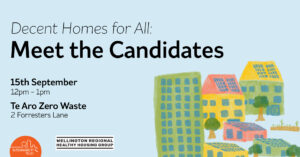

Imagine if everyone in New Zealand had a place to come home to where they could be comfortable and warm and breathe easy. We have the knowledge and capabilities to ensure every New Zealander can feel at home in their home. But we need to work together to make it happen – central government, councils, industry, research, finance, community organisations all have a role to play.
A decent home is warm, dry, accessible, and offers security of tenure. A decent home is what we want for ourselves, our neighbours and people in our communities. Decent homes allow us to get work and get to work and to keep kids in school. They keep us healthy. Decent homes are energy and water efficient – an essential part of the infrastructure that enables our communities to function, and councils to meet their climate and sustainability goals.
6 things your local councillors can do so all of us can live in decent homes: (Click on the text to read more about how each of these levers can work, and which councils are already doing it)
1. Reduce financing barriers for people who want to make healthy improvements, through the new Rates Assistance Scheme
We know that our homes need to be better insulated and have healthier heating but the up-front cost of these improvements can be a barrier. This barrier means too many of us are locked into living in mouldy, damp, cold homes that don’t look after us.
We can make health and efficiency improvements realistic for families in our communities. Councils in the past have offered long-term low-interest finance that is paid back via rates – but this has been hard for councils to manage on balance sheet. The proposed Rates Assistance Scheme (RAS) initiative, led by Local Government New Zealand, provides secure financing that is not part of council debt but can still be administered through rates – keeping the debt with the property that receives the benefit and allowing longer term and lower interest finance than banks.
Councillors can support the RAS and make it possible for more families to live with dignity in decent homes. Councils including Wellington City Council, Hutt City Council and Porirua City Council have already committed support to establish the Rates Assistance Scheme. Find a slideshow about the RAS and how it serves ratepayers and councils here.
2. Make independent advice for healthier and more efficient homes available by hosting independent advisors
People face conflicting advice on how to make their homes work for them. Information is patchy, often incorrect and sometimes linked to sales. Conflicting and sales-driven advice leads to inaction or solutions that fail to meet needs, keeping people locked in unhealthy homes that reduce their participation in school, work and their communities.
Homeowners need advice they can trust to be independent. Advisors hosted by council provide a trusted source, helping people make informed choices about where best to focus their resources to improve their homes. This benefits current and future households and the wider community. Independent advisors hosted by council puts council in housing conversations in a constructive and positive way. Advisors also provide a valuable resource for other parts of a council, ensuring decisions on consenting, planning, infrastructure, climate and sustainability consider the impact on – and opportunities in – decent homes.
A council’s role in housing is not just as an enforcer of regulations. For the cost of just one salary, a council can make available independent advice that removes barriers and supports people to improve their own homes in ways that benefit the community and planet. New Plymouth District, Tauranga District, Christchurch City, Dunedin City, and Auckland Councils host independent Eco Design Advisors. Learn more about the Eco Design Advisor service.
3. Enable enforcement of rental homes standards by having Health and Safety Officers refer to MBIE
Some people who provide rental homes are failing to meet their obligations and our current system puts the burden for enforcing the law heavily on the people who are renting non-compliant homes, who may not be in a strong position to hold their landlords to account. As a result, people in our communities are trapped renting unsafe and unhealthy homes.
While most people who provide rental homes have worked to ensure their housing meets or exceeds minimum Healthy Homes Standards (HHS), there are some who still fail to comply. Often the people renting these homes are among the least privileged in our communities – students, kaumatua, people who are disabled and people living with poverty. MBIE is tasked with monitoring and enforcing HHS compliance, but relies on spot-checks or renters having to report breaches. Support to identify breaches and refer these to MBIE can enable more effective and efficient monitoring and enforcement.
Councils have obligations under the Health Act 1965 and employ environmental health officers. These offers can play a role enabling MBIE to enforce Healthy Homes Standards so all renters get a fair go. Wellington City Council provides a model, having established a collaboration with MBIE that uses council Health Officers to refer some of the most unhealthy homes to MBIE for investigation.
4. Support a diverse housing system by making land available for social housing
Around the world, housing systems that rely only on private sector solutions have failed to ensure that everyone can live in a decent home. New Zealand is no exception.
Decent homes for all are basic infrastructure for well-functioning communities. Not being able to access homes that are fit-for-purpose leaves many in our communities struggling to participate in school, work and community activities. People experience high levels of stress, shame, and hospitalisation. In our small nation, the start-stop approach to public housing also impacts negatively on those who build homes, making it hard to invest in technology and skills for better homes, and increasing risk.
A diverse housing system is a strong housing system. State housing is a core component of a well-functioning housing system that meets our collective needs. Councils can play a key role to make land available, and ensure housing is built where infrastructure (pipes, transport options, amenities) can most efficiently be provided and in ways that benefit collective wellbeing through access to green spaces etc.
Councillors can ensure our housing is considered in long-term plans, and through housing and homelessness strategies. Council-owned land can be leveraged for housing that is both secure and affordable through shared-equity models. Where councils don’t want to administer housing themselves, they have partnered with independent specialist social housing entities to manage development and housing provision. Councils who provide good examples include: Wellington City Council, Hutt City Council, Kapiti Coast District Council.
Learn more abput the role of public housing at Public Housing Futures
5. Increase the number of healthier more efficient homes by incentivising developers
Houses that only meet the minimum levels of the Building Code can be too cold in winter and too hot in summer and hard to keep comfortable and free of mould. People living in these homes are more likely to have to take time off school and work, sport and volunteer roles.
Independent ratings such as Lifemark, Passive House, Homestar confirm the house is healthy, accessible and safe, energy efficient and low-carbon. They ensure homes that support thriving communities. These homes also benefit councils and communities by reducing infrastructure burden – water use, waste water and often transport.
Councillors can incentivise healthier homes by voting for development contribution discounts for homes independently certified to these standards. Ensuring healthy and energy efficient homes can support climate and energy goals and ensure constituent participation in community, work and school.
6. Ensure new developments contribute to affordable housing through inclusionary zoning tools
People building homes are strongly incentivised in our current system to prioritise profit above long-term householder and community wellbeing. The result has been new homes that are increasingly unaffordable, and still built to minimum standards that lock in poor health and low energy efficiency. This makes it even harder for people who need a decent place to live.
Inclusionary Zoning can be used to ensure a small part of the benefit from land re-zoning and development is directed to the public good (rather than individual wealth) through ensuring a proportion of homes in any new development are more affordable, or that a part of the value of the development is contributed to council to be used for to apply to decent affordable homes elsewhere.
A councillor can show they care by voting to make changes that ensure new housing development shares benefit to all people of their city, town or region. Queenstown Lakes District Council and Waipa District Council are examples where Inclusionary Zoning has worked. Read more here about how Inclusionary Zoning works.
Are you a voter?
>> Ask your candidates what they plan to do to support decent homes for everyone in your city, town or region. Find out who your local candidates are here: electionz.com
Are you a candidate?
>> Get familiar with the role councils can play to ensure we have a housing system that delivers for all by taking a look at our list above and examples from the councils who have done these things already.